 It's been about 2 1/2 months since leaving Shanghai now, and we started feeling the first pangs of travel-weary since the start of our journeys. Above, at over 12,000 feet elevation, Tiffany walks the famous Karkoram Highway, which leads from Xinjiang into Pakistan, as the Silk Road winds through the 20,000 ft plus mountain pass. It didn't help that she'd gotten her first bout of food poisoning since India, which made her not so excited about Xinjiang food anymore. Or that we felt like we were never going to get out of the hot, sandy desert at times. But she toughed it out, and we were rewarded with some amazing scenery, friendly locals, and another blog entry!
 Back in town, we decided maybe no more buying bread off the street was a good policy.
 Kashgar is famous for their Sunday Market, where farmers from all over bring their livestock and produce to trade and sell. We watched hundreds of market goers checking animal teeth, taking donkeys out for a test drive, and haggling for their life to finally complete a sale. In many cases, there is a 3rd party negotiator that acts as the go-between between buyer and seller.
 These two guarded their family donkey.
 Tiffany found her favorite animal, a brown fluffy donkey. We watched an under-1 year old donkey (about this size) that was touted for it's (relatively) calm demeanor, sold for 1700 RMB, or about $220. Not bad, unfortunately Tiff knew her donkey would never stand to be checked in at the airport, and had no chance of fitting into her carry-on bag.
 Hundreds of sheep lined up for sale. Farmers would shave their flock in a distinctive style, like a brand, for identification purposes.
 Another part of the market specialized in various handicrafts, like these fancy versions of the common Uigher hat.

This area of Xinjiang is famous for the "smallest hat in the world". How they know that, who knows, it's not actually all that small, but whatever. Zach is styling a tiny black silk number, with baby blue topping.
 We came across this colorful brood in the old town of Kashgar (most recently used in the Kite Runner film due to it's proximity to and resemblance of Afganistan). This was the first of about 50 photos that this giggly group of girls demanded to take, swarming Zach after each one to critique the result, then running back to pose for the next one.
 Zach closes the deal with a knife salesman in a town outside of Kashgar, called Yengisar. The blades are hammered out by hand, along with various handle types made of wood, bone, even deer antlers, and inlaid or encrusted with jewels, mother-of-pearl or other decoration. The salesman then took us up the dirt road to his home, where his colleage sharpened each knife while we enjoyed looking around their simple home.
 At the knife salesman's house, Tiffany and our guide, Aliya, relax for a moment. The family was incredibly hospitable, offering to climb their tree to pick us some fresh apricots for a snack while we waited for the knives to be sharpened. Aliya was a fantastic guide and was interestingly enough a Muslim (but recently converted Christian) who competes in Hip Hop dancing competitions when not leading hapless tourists around Xinjiang.
 Tiff half-heartedly prepares herself for another Uigher lunch. Zach loved the "lakh man", made of fresh, hand-pulled noodles and topped with tomato sauce and slices of lamb.
 Noshing in China?? Uighers are famous for their "girde nan" and love to eat it in the mornings. They were delicious, thick and dense, sometimes baked with salt crystals in the dough, and always crisp and extra chewy on the bottom, where they dough sat in the hearths. If only they had some low-fat schmear to spread on it...
 No vampires here!
 Fresh lamb for sale.
 It was like the Cirque du Soleil of chickens, hung like they were acrobatically balanced in the air.
 It always struck us how non-chalantly large sides of meat were hung in the street.
 A rare sight in the officially "no religion" China. Friday afternoon brings a crowd of the largely Muslim population to pray at one of the many mosques we saw in Xinjiang.
 The most fuel-efficient vehicle on the planet!
 The standard package in one of our hotels, the swatter unfortunately came in very handy.
 At a silk farm, we watched the silk eggs getting boiled and threads drawn out, for these weavers to form into various scarves and clothing.
 Part of the Himalayan mountain range, the snow-capped peaks made for a stunning backdrop as we visited Karakul Lake. The vaunted K2 mountain (named for being the 2nd peak of the Karakoram range), second highest in the world, is nearby.
 Out in the desert we explored the Thousand Buddha Caves, home to an ancient monastary of Buddhist monks with individual chambers carved into the stone face.
 Top 10 Jobs Zach Wouldn't Last 2 Days At - In order to prevent the desert from completing overtaking and obscuring the road (this was the Cross-Desert Highway, an ardous 12-hour drive we undertook one day), the government decided to plant vegetation along the shoulder to trap and filter the grainy environment. Unfortunately, some poor souls need to be out there to water the plants. So two people are hired to live in one of these desolate, oven-like outposts in the middle of the desert -- and water the plants every day. These buildings dotted the highway every 3-5 miles or so. One tour of duty lasts 3 months (after that you fall prey to desert madness maybe?) and pays about $400/month. Food and fresh water have to be trucked in once a week to keep them alive. Unsurprisingly, the majority of desert gardeners are not locals, but immigrants from another province who are just poor and unknowing enough to sign up for the job. When not even the native desert folks want the job, you gotta wonder...
 A minor delay in our journey across the Taklamakan desert caused by some wayward camels.
 A mosque and burial ground for the sacred Islamic Yarkent King, about a 20 minute walk into the desert. A sandy wind is swirling around, and Tiffany was not happy.
 Amazingly, even out in the middle of this desert, Zach found a bright flower somehow flourishing.
 We came across this colorful brood in the old town of Kashgar (most recently used in the Kite Runner film due to it's proximity to and resemblance of Afganistan). This was the first of about 50 photos that this giggly group of girls demanded to take, swarming Zach after each one to critique the result, then running back to pose for the next one.
 Zach closes the deal with a knife salesman in a town outside of Kashgar, called Yengisar. The blades are hammered out by hand, along with various handle types made of wood, bone, even deer antlers, and inlaid or encrusted with jewels, mother-of-pearl or other decoration. The salesman then took us up the dirt road to his home, where his colleage sharpened each knife while we enjoyed looking around their simple home. At the knife salesman's house, Tiffany and our guide, Aliya, relax for a moment. The family was incredibly hospitable, offering to climb their tree to pick us some fresh apricots for a snack while we waited for the knives to be sharpened. Aliya was a fantastic guide and was interestingly enough a Muslim (but recently converted Christian) who competes in Hip Hop dancing competitions when not leading hapless tourists around Xinjiang.Tiff half-heartedly prepares herself for another Uigher lunch. Zach loved the "lakh man", made of fresh, hand-pulled noodles and topped with tomato sauce and slices of lamb. Noshing in China?? Uighers are famous for their "girde nan" and love to eat it in the mornings. They were delicious, thick and dense, sometimes baked with salt crystals in the dough, and always crisp and extra chewy on the bottom, where they dough sat in the hearths. If only they had some low-fat schmear to spread on it...
 No vampires here!
 Fresh lamb for sale. It was like the Cirque du Soleil of chickens, hung like they were acrobatically balanced in the air. It always struck us how non-chalantly large sides of meat were hung in the street.
 A rare sight in the officially "no religion" China. Friday afternoon brings a crowd of the largely Muslim population to pray at one of the many mosques we saw in Xinjiang.
 The most fuel-efficient vehicle on the planet!
 The standard package in one of our hotels, the swatter unfortunately came in very handy.
 At a silk farm, we watched the silk eggs getting boiled and threads drawn out, for these weavers to form into various scarves and clothing.Part of the Himalayan mountain range, the snow-capped peaks made for a stunning backdrop as we visited Karakul Lake. The vaunted K2 mountain (named for being the 2nd peak of the Karakoram range), second highest in the world, is nearby.
 Out in the desert we explored the Thousand Buddha Caves, home to an ancient monastary of Buddhist monks with individual chambers carved into the stone face.
 Top 10 Jobs Zach Wouldn't Last 2 Days At - In order to prevent the desert from completing overtaking and obscuring the road (this was the Cross-Desert Highway, an ardous 12-hour drive we undertook one day), the government decided to plant vegetation along the shoulder to trap and filter the grainy environment. Unfortunately, some poor souls need to be out there to water the plants. So two people are hired to live in one of these desolate, oven-like outposts in the middle of the desert -- and water the plants every day. These buildings dotted the highway every 3-5 miles or so. One tour of duty lasts 3 months (after that you fall prey to desert madness maybe?) and pays about $400/month. Food and fresh water have to be trucked in once a week to keep them alive. Unsurprisingly, the majority of desert gardeners are not locals, but immigrants from another province who are just poor and unknowing enough to sign up for the job. When not even the native desert folks want the job, you gotta wonder...
 A minor delay in our journey across the Taklamakan desert caused by some wayward camels.
 A mosque and burial ground for the sacred Islamic Yarkent King, about a 20 minute walk into the desert. A sandy wind is swirling around, and Tiffany was not happy.Amazingly, even out in the middle of this desert, Zach found a bright flower somehow flourishing.


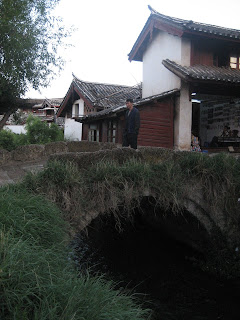 The town was filled with old Naxi architecture and the streets were mazes of small cobblestone streets and quant streams and bridges.

 Here's Zach relaxing in our zen hotel courtyard.
 After wandering through the quaint maze of streets in old town, we hopped on bikes and cruised around the surrounding farmlands.
 We didn't get far before getting caught in some rush hour traffic...
 It was amazing to bike by farmers working the land as their ancestors have for probably hundreds of years. It's about as far away from modern China as you can imagine.
 The farms were so beautiful and surrounded by mountains. And the people we ran into were so friendly and nice, and they were quick to wave and smile at two random foreigners biking around their farms.
 It was such a peaceful and reassuring re-entry into China, and also fun to see such different sides of the country.

 We finished up a great stay in Sydney and spent our last days walking as much as possible through this beautiful city. Lots of beautiful buildings, like St. Mary's Cathedral, above, left us in awe of this city which before now we'd known very little about.


 As we reluctantly leave our new favorite country, we are getting ready to re-enter China, the chaotic, exciting country we've called home for the past 3 years. With the unfortunate situations in Chengdu and Tibet, we're shifting our trip to Yunnan, the most southeastern province of China and home to